Can Inflammation Cause Piriformis Syndrome?
Piriformis syndrome is commonly associated with irritation or compression of the sciatic nerve near the piriformis muscle. While muscle overuse, injury, prolonged sitting, and anatomical differences are often discussed as contributing factors, inflammation may also play an important role. Understanding what is driving that inflammation—and why the piriformis muscle and surrounding tissues are reacting—may be particularly important when symptoms are persistent or repeatedly return.
Yes, Inflammation Can Contribute to Piriformis Syndrome
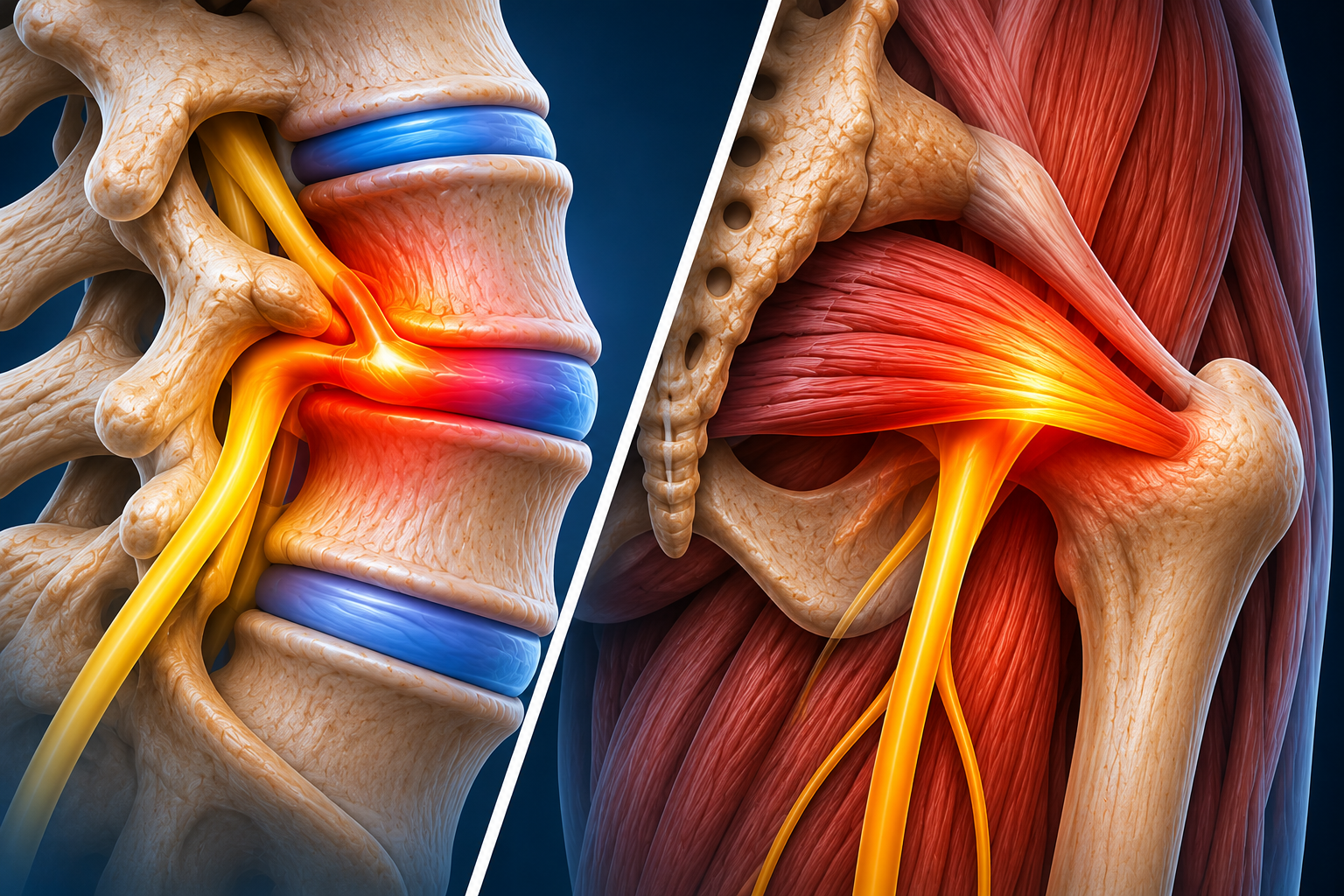
Inflammation involving the piriformis does not always present in the same location or appear to have the same cause. In my clinical experience, tenderness may be concentrated near the tendon and its insertion at the greater trochanter of the femur, within the belly of the piriformis muscle, or closer to its origin at the sacrum. The location and character of these findings can provide useful clues about what may be contributing to the patient’s symptoms.
Muscle-belly tenderness is often easier to associate with a mechanical cause. Strenuous exercise, repeated squatting, prolonged bending, or excessive and repetitive stretching may irritate the piriformis and surrounding tissues. In some patients, excessive stretching may also accompany increased joint mobility or instability rather than correcting the underlying problem.
Just as importantly, pain in the piriformis region does not necessarily mean that the piriformis is the source. Lumbar disc disorders and other causes of nerve-root irritation can refer pain into the buttock and produce symptoms that resemble piriformis syndrome. For that reason, I consider the location of reproducible tenderness and the rest of the examination before assuming that buttock or sciatic-type pain originates in the piriformis itself.
Why the Location of Piriformis Tenderness Matters
In my examination, I pay close attention to exactly where tenderness is reproduced. I generally see three patterns: tenderness near the piriformis tendon and its insertion at the greater trochanter of the femur, tenderness within the muscle belly, and tenderness closer to the piriformis origin at the sacrum. These patterns do not necessarily have the same underlying cause.
Tenderness within the muscle belly more often accompanies an identifiable mechanical stress, such as strenuous exercise, repeated squatting, prolonged bending, or excessive stretching. By contrast, when tenderness is concentrated near the tendon or its bony attachment, I look more closely for factors beyond simple overuse.
The location of tenderness also helps determine whether the piriformis is likely to be the primary problem at all. When a patient has buttock or sciatic-type pain but little or no reproducible piriformis tenderness, I consider lumbar disc involvement and other sources of referred or radicular pain rather than automatically labeling the condition piriformis syndrome.
When Piriformis Inflammation May Not Be Just a Mechanical Problem
Not every patient with piriformis inflammation has an obvious mechanical explanation. When there has been no unusual exercise, injury, prolonged sitting, or other clear physical trigger, simply identifying a painful piriformis muscle does not answer the most important question: Why is it inflamed?
For more than 20 years in the Chapel Hill area, I have been examining these patterns in patients with recurring musculoskeletal problems. During that time, I have focused not only on identifying which muscle, tendon, joint, or nerve is painful, but also on understanding the underlying mechanisms that may be contributing to inflammation in a particular tissue.
In patients with piriformis symptoms, the location of tenderness can be particularly informative. Tenderness at the tendon attachment, within the muscle belly, or near the sacral origin may lead me in different directions during the examination. My approach incorporates a detailed musculoskeletal examination along with principles of Applied Kinesiology to look for patterns that may not be apparent when the painful area is considered in isolation.
Some of the patterns I have observed extend beyond conventional mechanical explanations. Depending on the examination findings and the patient’s history, I may investigate physical stresses as well as dietary, medication-related, metabolic, gastrointestinal, and stress-related factors that could be contributing to the inflammatory response.
These clinical patterns have developed through more than two decades of examining and treating patients in Chapel Hill. They do not mean that every patient with piriformis syndrome has the same underlying cause. The objective is to determine which factors may be relevant to the individual patient rather than assuming that every painful piriformis muscle simply needs to be stretched, massaged, or strengthened.
As a Chapel Hill chiropractor, one of the questions I consider particularly important in recurrent cases is not simply “Where does it hurt?” but “Why does this particular tissue keep becoming irritated?” For patients whose symptoms repeatedly return despite treating the painful area, investigating the factors contributing to that pattern may provide an important piece of the puzzle.
Is It Piriformis Syndrome or a Herniated Disc?
Pain in the buttock, hip, or back of the leg is often assumed to be piriformis syndrome, but the piriformis is not always the source. A lumbar disc problem can irritate a nerve root and produce pain, numbness, tingling, or other symptoms that travel through many of the same areas associated with piriformis syndrome.
This is one reason the physical examination matters. When the piriformis itself is involved, I typically expect the examination to reproduce findings in the muscle, tendon, or attachment areas. In patients whose symptoms are originating from a lumbar disc, the pattern can be quite different. The patient may describe pain in the piriformis or gluteal region even though examination of the piriformis does not reproduce the findings I would expect from a primary piriformis problem.
Distinguishing between these possibilities is important because treating the piriformis will not correct a problem that is actually originating in the lumbar spine. In my Chapel Hill chiropractic practice, I evaluate the lumbar spine, discs, surrounding muscles and joints, neurological findings, and the specific areas of tenderness before deciding whether the piriformis appears to be the primary problem or simply the location where the patient feels the symptoms.
Why Does Piriformis Syndrome Keep Coming Back?
When piriformis symptoms repeatedly return, I become less interested in simply treating the painful muscle and more interested in understanding why the same tissue keeps becoming irritated. Stretching, massage, exercise, chiropractic treatment, or other therapies may reduce symptoms, but recurrent pain suggests that an underlying contributing factor may still be present.
Sometimes that factor is mechanical. Repetitive exercise, altered movement patterns, excessive stretching, joint instability, prolonged postures, or irritation originating from the lumbar spine can continually place stress on the region. In other patients, however, the examination does not fit a straightforward mechanical pattern.
This is where more than 20 years of observing patients in my Chapel Hill chiropractic practice becomes particularly useful. I have identified recurring examination patterns that can lead me to investigate factors well beyond the painful muscle itself. Depending on what I find, that may include physical stresses as well as dietary, gastrointestinal, medication-related, metabolic, or stress-related influences.
The goal is not to assume that every patient has a hidden systemic problem. It is to avoid assuming the opposite—that every case of piriformis pain is simply a tight muscle that needs more stretching. In some patients, repeated stretching may actually aggravate the problem, particularly when excessive mobility or instability is already part of the pattern.
For patients who have tried repeatedly treating the piriformis only to have the symptoms return, asking why the problem keeps recurring may be more useful than simply treating the same painful area again.
When Should You Have Piriformis Pain Evaluated?
Piriformis pain is worth evaluating when it persists, repeatedly returns, interferes with walking, sitting, exercise, or sleep, or begins to produce symptoms extending into the hip or leg. An evaluation is particularly useful when stretching, massage, exercise, or other treatments provide only temporary relief and the same problem keeps returning.
A thorough examination should also consider whether the symptoms are actually originating from the piriformis. Lumbar disc problems, nerve irritation, hip and pelvic conditions, and other sources of referred pain can produce symptoms in the same general area. Identifying the likely source of the symptoms is an important first step before deciding how the problem should be treated.
Certain symptoms deserve prompt medical evaluation rather than assuming the problem is muscular. New or progressive weakness, significant numbness, loss of bowel or bladder control, numbness in the groin or saddle region, fever or systemic illness, unexplained weight loss, or significant new bowel, urinary, or pelvic symptoms should be medically evaluated.
Looking for a Chiropractor for Piriformis Pain in Chapel Hill?
If you have persistent or recurring pain in the piriformis, buttock, hip, or leg, the first step is determining where the symptoms are actually coming from. At Chapel Hill Chiropractic Centre, I take the time to evaluate the painful area while also looking for mechanical and other contributing factors that may help explain why the problem developed or continues to return.
After more than 20 years of examining these patterns in the Chapel Hill area, my approach is focused on the individual patient rather than applying the same treatment to every person with similar symptoms.
If you would like to schedule an evaluation, call or text Chapel Hill Chiropractic Centre at 919-968-4417 or use our online appointment request.